Buying Land in Oconee County, GA: What to Review First
June 25, 2026
June 25, 2026
Wondering if that beautiful piece of land in Oconee County is actually buildable? You are not alone. Buying residential land can open the door to a custom home, more privacy, or a long-term investment, but it also comes with more moving parts than buying an existing house. If you are considering land in Oconee County, it helps to know what to check before you close so you can avoid surprises and move forward with confidence. Let’s dive in.
In Oconee County, land decisions are not just about how many acres a parcel has. The county’s planning and code process ties land use, water, wastewater, transportation, and development regulations to the Comprehensive Plan.
That means two parcels with similar size can have very different development potential. Before you focus on house plans or price alone, you need to understand what the property allows, what it needs, and what could limit your plans.
Zoning is the first checkpoint when buying residential land in Oconee County. The county says buyers can identify zoning through the Property Appraisal Office map, and the zoning map was officially readopted on March 4, 2025, to reflect rezoning changes and conditional rezonings.
This step helps you confirm whether your intended use fits the parcel as it stands today. If you want to build a primary home, add another homesite, or create a different lot layout, zoning should be verified before you go much further.
Zoning can shape setbacks, lot width, frontage, and other development standards. Even if a parcel looks ideal on paper, those rules may affect where a home can sit and how much of the property is truly usable.
If the property does not fit your intended use cleanly, relief is not automatic. Oconee County treats special exception variances, hardship variances, flood-damage variances, and administrative appeals as separate processes.
Special exception variances can apply to items such as setbacks, lot width, public street frontage, grading and draining, private access drives, and the number of lots off a private access drive. That can be helpful, but it is still a formal process, not a shortcut.
If your purchase depends on one of those approvals, it is smart to understand that risk early. A parcel that works today without extra approvals is often simpler than one that needs exceptions to become usable.
If you hope to split land or create more than one homesite, subdivision status matters right away. Oconee County distinguishes between minor subdivisions and major subdivisions, and the difference can affect cost, timeline, and design.
Minor subdivisions can include certain recombinations and lot splits. Major subdivisions generally involve new streets, stormwater facilities, or utility improvements.
One minor subdivision category allows up to five lots to front on a private access drive if the drive fronts at least 40 feet on a paved public street. That may sound like a small detail, but it can make a big difference if you are evaluating a family land split or a small multi-lot plan.
This is one reason parcel-specific review matters so much in Oconee County. A tract may look like it has room for several homes, but layout and frontage rules can still limit what is possible.
Not every land sale is intended to become a buildable homesite. County rules say a non-development land sale applies to land where no new roads, utilities, sanitary sewer, or septic approval is required.
The recorded plat for that kind of tract must state that it is not eligible for sanitary sewer or septic tank approval. In plain terms, some parcels may transfer legally but still not work for a future home.
One of the biggest mistakes land buyers make is assuming utilities are available. In Oconee County, public water and sewer serviceability must be verified before an account can be opened, and the county requires an application, deposits, and service charges.
The county also says it does not provide same-day service. If public water or sewer is not available, the parcel may need a private well, a septic system, or both.
Environmental Health is the local office that handles sewage and septic systems and well water. Septic feasibility depends heavily on the site itself, including soils, slope, drainage, and other physical conditions.
Georgia’s current onsite sewage manual says septic site plans may need 2-foot contour topography, driveways, setbacks, utilities, wells, water bodies, drainage ways, wetlands, floodplains, and easements. On challenging sites, marginal soils or restrictive topography can require an engineered plan from a Georgia-registered engineer.
The same state manual says absorption fields should not be installed on slopes over 25% unless special investigations support the design. It also sets percolation thresholds for conventional systems, with different standards depending on parcel size.
Engineered plans should also show at least 24 inches of vertical separation to groundwater, rock, or impervious layers. In real life, that means the parcel’s buildable area may be smaller than it first appears.
Even when public utilities are nearby, their layout matters. Oconee County water standards place water mains in rights-of-way or easements and call for a minimum 20-foot water-main easement when an easement is used.
That can affect the buildable envelope and the placement of your home, driveway, and other improvements. Electrical service should also be confirmed parcel by parcel, since the county’s residential permit application lists Walton EMC, Georgia Power, and Rayle Electric as possible providers.
Access is another area where buyers should slow down and verify details. Oconee County’s Road Book can be helpful, but the county clearly warns that it is not a legal document.
The county also says right-of-way information may not be accurate and should be verified with a licensed surveyor or attorney. If a parcel’s value depends on frontage or access, this step is especially important.
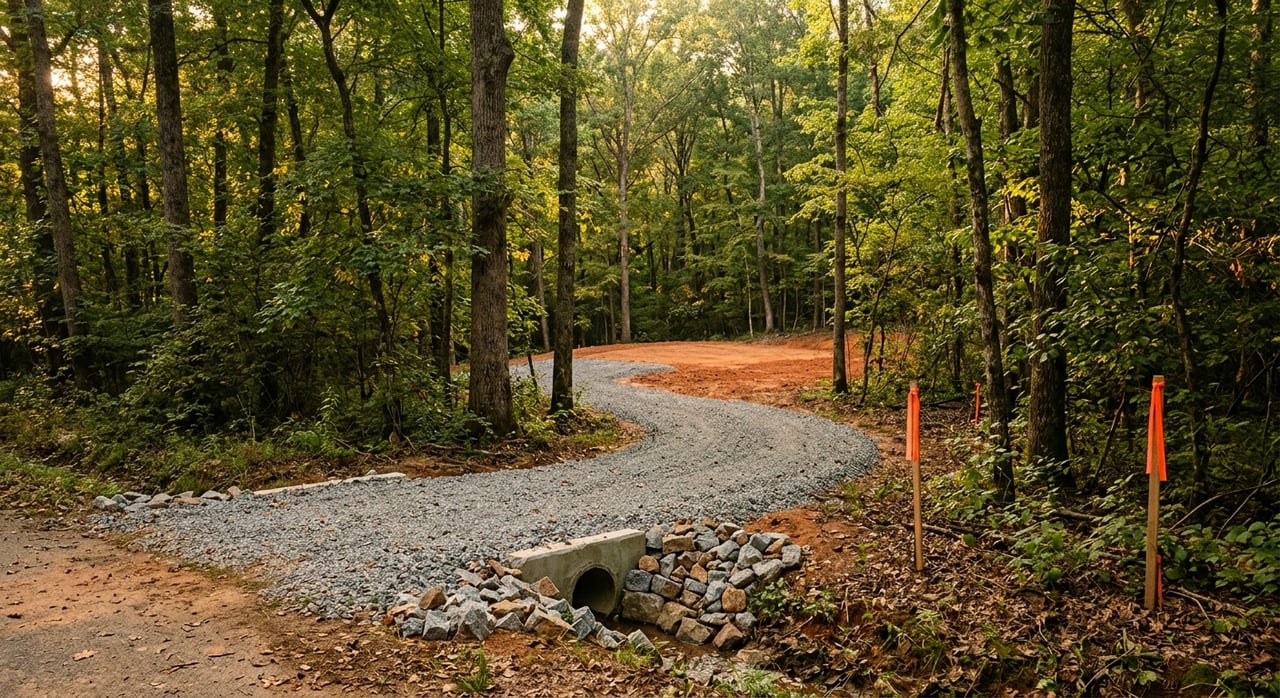
In Oconee County, driveway access is a formal approval item. The driveway permit application says applicants must contact the Road Department for inspection, then bring the approved form to Code Enforcement for issuance.
For new-construction homes, driveway approval is needed when the building permit is submitted. If the lot accesses county or state right-of-way, a driveway permit is required.
County plat checklists require details such as county road right-of-way, private access easements and driveways, lot boundaries, building setback lines, and environmental areas. That tells you how important survey-level boundary work is before you commit.
This is also where topography begins to matter more. The residential building permit application says structures or irrigation are prohibited within county right-of-way, drainage easements, buffer areas, floodplain, or within 25 feet of state waters without prior approval.
Topography is not just a design concern. In Oconee County, it can determine whether the lot is feasible in the first place.
County subdivision rules say yield plans must be based on accurate topography, a boundary survey, and a Level Two Soil Scientist report or greater. Conservation subdivision rules also note the goal of preserving steep slopes, wetlands, unsuitable soils, stream corridors, and other sensitive areas in open space.
Before closing, check whether the parcel includes wetlands, the 100-year floodplain, state waters, or conservation corridors. Oconee County’s plat checklist requires those features to be shown.
If a conservation corridor exists, the checklist calls for a 50-foot undisturbed buffer from the stream bank plus an added impervious-surface setback tied to the zoning district setback. That can significantly reduce where you can place a house, driveway, or other improvements.
Once you own the land, Oconee County’s build process is permit-heavy and sequential. The residential permit application says separate plumbing, electrical, gas, and HVAC permits must be purchased before work begins.
It also requires soil-erosion measures on all jobs. Work started without a permit can trigger a triple permit fee.
The county says grading, digging, and stump removal are not allowed until the building permit is issued. Permits can expire if work is not started within six months, and occupancy is unlawful without a certificate of occupancy.
If public service extensions are needed, Water Resources uses separate water-system and sanitary sewer extension applications. Required inspection sheets call for at least two business days’ notice before several water and sewer inspections, including before construction begins and before backfill.
If you are comparing multiple parcels, it helps to review them in a practical sequence. In Oconee County, that sequence is supported by county zoning, subdivision, road, building permit, utility, and environmental health rules.
A simple order to follow is:
Following that order can save you time, money, and frustration. It also makes it easier to identify which parcel truly supports your goals instead of just looking promising from the road.
Buying land in Oconee County is often more nuanced than buying an existing home. Parcel layout, septic conditions, access approvals, utility service, and environmental constraints can all affect whether a property works for you.
That is why local, property-specific guidance matters. When you have a clear understanding of the county’s process and a practical plan for due diligence, you can make a stronger decision and move forward with more peace of mind.
If you are thinking about buying residential land in Oconee County, Madi McPhillips can help you evaluate opportunities with a local perspective and a thoughtful, step-by-step approach.
Stay up to date on the latest real estate trends.




Madi McPhillips offers refined representation backed by deep local expertise and strong community ties. With strategic insight and skilled negotiation, she delivers elevated service and exceptional results across the Greater Athens market.